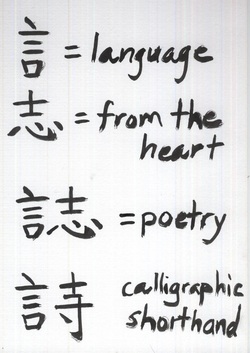
The Chinese word for poetry, shih, means "language from the heart."
| Teresa Mei Chuc (Tuệ Mỹ Chúc) |
|
|
The Chinese word for poetry, shih, means "language from the heart."
0 Comments
from The Other Voice by Octavio Paz -- “The operative mode of poetic thought is imagining, and imagination consists, essentially, of the ability to place contrary or divergent realities in relationship. All poetic forms and all linguistic figures have one thing in common: they seek, and often find, hidden resemblances. In the most extreme cases, they unite opposites. Comparisons, analogies, metaphors, metonymies, and the other devices of poetry—all tend to produce images in which this and that, the one and the other, the one and the many are joined. The poetic process conceives language as an animated universe traversed by a dual current of attraction and repulsion. In language, the unions and the divisions, the love affairs and the separations of stars, cells, atoms, and men are reproduced. Each poem, whatever its subject and form and the ideas that shape it, is first and foremost a miniature animated cosmos. The poem unites the “ten thousand things that make up the universe,” as the ancient Chinese put it.” "Hugo said it in a magnificent phrase: Tout cherche tout, sans but, sans treve, sans repos- Everything seeks everything, without purpose, without end, without cease. The relationship between man and poetry is as old as our history: it began when human beings began to be human. The first hunters and gathers looked at themselves in astonishment one day, for an interminable instant, in the still waters of a poem. Since that moment, people have not stopped looking at themselves in the mirror. And they have seen themselves, at one and the same time, as creators of images and as images of their creations. For that reason I can say, with a modicum of certainty, that as long as there are people, there will be poetry. The relationship, however, may be broken. Born of the human imagination, it may die if imagination dies or is corrupted. If human beings forget poetry, they will forget themselves. And return to original chaos." Some of my favorite quotes from Nine Gates by Jane Hirschfield:
"Chance is the fundamental workings of the creative mind." "There is reason to fear: a great poem, like a great love, challenges our solitude, our conceptions, the very ground of our being. Encountering such a poem, we tremble a little as we enter its gates. But the end, as in love, is to know and feel what could not be known or felt by any path less demanding." "...for giving oneself to the lion, or to poetry, is a vow- nothing more, nothing less than one's entire life will be asked." I am reading Becoming the Villainess by Jeannine Hall Gailey. So many poems in this book I just adore and I love the feminist edge. I am planning a poetry unit for my high school students around poems in the book. Still in the works right now, but hopefully my girl students, especially, will feel empowered by the poems.
Here is a poem from the book: PLAYING SOFTBALL WITH PERSEPHONE She throws that heavy globe so that it sinks in the dirt a gash in semisoft mud around the shoe-crushed wildflowers and the gnats ring her hair like a crown. She looks right at me while she drinks Gatorade, pulling her sweaty bangs up over her face and her eyes like a whole field of forget-me-nots. The ball rolls forward and she grabs it, squeezes it like a ripe pomegranate, almost takes a bite, then wipes her mouth on her dusty arm. I am currently reading To the Place of Trumpets by Brigit Pegeen Kelly, her first poetry book. I was going to buy it so that I would have her whole collection. I currently have Song (her second poetry book) and Orchard (her third poetry book). Both incredible books. To my surprise, To the Place of Trumpets costs over $100; it must be a collector's item now. So, I checked it out from the Elliot Pratt Library and conscientiously turn the pages gently.
Here is a poem from the book (I was not able to do some indentations correctly in the first part due to formatting problems): Those Who Wrestle with the Angel for Us i. My brother flies A plane, windhover, night-lover, Flies too low Over the belled and furrowed fields, The coiled creeks, The slow streams of cars spilling Like lust into the summer Towns. And he flies when he Should not, when The hot, heavy air breaks In storms, in high Winds, when the clouds like trees Unload their stony fruit And batter his slender wings and tail. But like the magician's Dove, he appears home safely every time, Carrying in his worn white Bag all the dark elements That flight knows, The dark that makes his own soul Dark with sight. ii. Even when he was a child, his skin was the white Of something buffed by winds at high altitudes Or lit by arctic lights--it gleamed like fish scales Or oiled tin, and even then he wished to be alone, Disappearing into the long grasses of the Ipperwash dunes Where the gulls nested and where one afternoon He fell asleep and was almost carried off by the sun-- In his dream he was running, leaping well, leaping High as the hunted deer, and almost leaping free, But like the tide, my gentle-handed mother hauled him back With cold compresses and tea, and after that he favored The dark, the ghostly hours, a small boy whistling in our yard As he dragged a stick along the fence rails, and listened To the slatted rattle of railroad cars, and knew by Instinct how railroad lines look from the air, like ladders Running northward to the stars, to the great constellations. And he began then tracking his way through the names Of all our fears, Cassiopeia, Andromeda, the shining Ram, Tracking the miles and years he logs now, the lonely stretches Where he finds the souvenirs that light our narrow kitchens-- Buckles and pins, watches and rings--the booty That makes our land-locked, land-bound souls feel the compass In our feet, and see in those who never speak, who Slouch in with the dust of the northern wind on their backs, The face of the angel we ourselves must wrestle with. |
AuthorTeresa Mei Chuc is a writer of poetry and creative non-fiction. Archives
June 2023
Categories
All
|
 RSS Feed